
How to Pack and Move Lawn Equipment
Lawn equipment is the category of household belongings that gets the most people in trouble on move day. I’ve seen it happen more than once: the moving crew arrives, sees a mower with gas in the tank, and either refuses to load it or loads it anyway and creates a problem in transit. Neither outcome is good.
How much will my move cost?
Let us help match you
Thank you!
Your movers will contact you shortly.

Written by: All Movers Team
AllMovers team provides expert insights, mover comparisons, and practical resources to help you make informed moving decisions. Whether you need company reviews, relocation tips, or expert guidance, we’ve got you covered. Read more
Reviewed by: Jason Walker
Jason Walker is a moving expert with personal and professional experience, sharing tips, guides, and reviews to make your relocation stress-free. Read more
Last Update: 06/05/2026
Before moving any lawn equipment, you must drain all gasoline and oil – this is non-negotiable whether you’re hiring movers or renting a truck yourself.
Movers are legally prohibited from transporting equipment with fuel in the tank, and gas-filled mowers in enclosed trucks are a fire risk. Beyond that: disconnect the spark plug, clean the deck, wrap or strap it securely, and for riding mowers, plan for a trailer rather than a moving truck.
The process isn’t complicated, but it has a specific sequence that matters. Here’s how to prepare each type of equipment so the move goes cleanly.
- Gasoline and oil must be completely drained before any lawn equipment goes on a moving truck. This applies whether you’re using professional movers or a DIY rental.
- Even an “empty” gas tank has residual fumes. After draining, leave the cap off in a ventilated area for at least an hour before loading.
- Disconnect the spark plug before transport. Residual fumes plus vibration can cause an engine to fire unexpectedly.
- Riding mowers and garden tractors don’t belong in standard moving trucks – they’re better transported in a utility trailer or via a dedicated equipment hauler.
- Fertilizers, pesticides, and herbicides are also prohibited by most movers. Plan to use them up, give them away, or dispose of them before your move.
Most Recommended Mover for 2026 Most Recommended Mover for 2026


- Nationwide moving support
- Clear estimates, no hidden fees
- One team manages every stage
Need Help? Call Now
800-457-0021- Nationwide moving support, clear estimates & no hidden fees, one team for every stage
Fast Response Guaranteed Fast Response Guaranteed

- Long-distance moving expertise
- Value-focused pricing approach
- Proven moving industry experience
Call for a Free Quote
888-450-9884- Long-distance moving expertise, value-focused pricing, proven industry experience

- Reliable moving & Storage solutions
- Top-quality services, trained staff
- Reliable moving & storage solutions, top-quality services, trained staff
Why the Fuel Rule Is Non-Negotiable
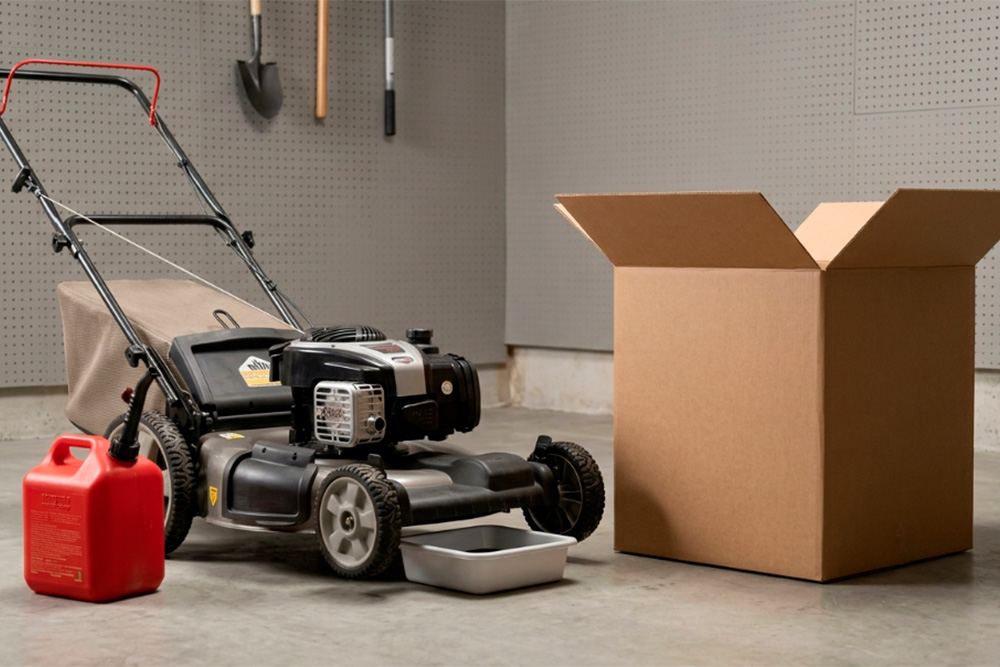
Professional movers are bound by FMCSA regulations that prohibit transporting hazardous materials, and gasoline qualifies. An enclosed moving truck in summer heat can reach internal temperatures well above 100°F. Gasoline expands with heat and creates vapor pressure – a small leak from an improperly sealed tank or fuel line becomes a serious fire risk in a sealed truck cabin full of furniture.
This isn’t a technicality that movers enforce inconsistently. Most legitimate moving companies will refuse to load any equipment with fuel present, and some inspect mowers before loading. If they miss it and something happens in transit, your claims coverage is voided.
Gasoline begins to degrade in as little as 30 days when stored in a tank without a fuel stabilizer. Old, partially oxidized gas is actually more volatile and harder to combust predictably than fresh gas – which is part of why the fire risk from “old gas” in a hot truck is higher than it might seem. Using a fuel stabilizer if you need to store a mower for more than a month is worth the $5 it costs.
How to Drain Gas From a Push Mower
The simplest method: run the mower until it runs out of fuel. Start it in your yard and let it idle until the engine sputters and stops. This uses the gas productively rather than disposing of it, and leaves the tank with the minimum residual fuel possible.
If you don’t want to run it dry, siphon the gas with a hand pump siphon into an approved gas container (red, sealed plastic or metal fuel can). Don’t use food containers, water bottles, or anything not rated for fuel. Siphon from the tank access point or directly through the fuel line if accessible.
After draining:
- Leave the fuel cap off and place the mower in a well-ventilated area (outdoors is ideal) for at least an hour. This lets fumes dissipate.
- Replace the cap loosely – don’t seal it tight – during transport to allow any remaining vapor pressure to escape.
- Drain the oil separately. Oil doesn’t create fire risk the same way gas does, but it will leak and make a mess if the mower is tipped. Use a drain pan and dispose of the oil at a local auto parts store (most accept used oil for free).
Get matched with the best mover for your needs!
Thank you!
Your movers will contact you shortly.
How to Disconnect the Spark Plug
After draining fuel, this is the most important safety step. Use a spark plug wrench to remove the plug – or simply disconnect the spark plug wire if you don’t want to fully remove it. Either method prevents the engine from accidentally starting due to residual fuel or vapor during transport.
Put the spark plug or the disconnected wire in a small zip-lock bag and tape it to the mower somewhere visible, so you know exactly where it is when you need to reconnect on the other side.
A gasoline engine can actually start with no liquid fuel in the tank if there’s enough fuel vapor present and the spark plug is connected. This is rare, but it’s documented – and it’s the reason disconnecting the spark plug is a real precaution rather than excessive caution. Vibration during transport can position the piston in a way that causes compression, which combined with vapor and a connected spark plug creates the right conditions.
Cleaning and Prepping the Mower Deck
The underside of a mower deck accumulates grass clippings, mud, and moisture. In a moving truck, that debris transfers to other items and can cause rust or staining if the mower is stored next to furniture, mattresses, or boxes.
Use a garden hose, a stiff brush, and a scraper to clean the underside of the deck thoroughly. Give it time to dry completely before wrapping or loading – a wet mower deck sealed in moving blankets can develop rust during a long transit. The same wrapping approach applies to other large, awkward items: see our guide on how to move a mattress for blanket-wrapping and strapping technique that transfers directly to mower protection.
For the blades: if you’re removing them for separate transport, use heavy gloves and wrap each blade in thick cloth or bubble wrap before packing in a box labeled “sharp.”
If the blades are staying on the mower, the original plastic blade guards (if you still have them) are the best protection. If not, wrap the blade area with moving blankets and secure with tape or straps.
How to Pack a Push Mower for the Truck
Push mowers can go in a standard moving truck, provided the fuel is drained. Here’s how to load them correctly:
- Fold the handle down if your mower has a foldable handle – this reduces height significantly.
- Wrap the mower body in a moving blanket, secured with tape or rubber bands. Focus coverage on the engine block and the deck edges.
- Position the mower in the truck with the wheels perpendicular to the truck’s wheels – meaning the mower should face sideways in the truck rather than front-to-back. This reduces rolling during braking and acceleration.
- Strap it to the truck wall using tie-down straps or ratchet straps. Don’t rely on surrounding boxes to hold it in place – a mower is heavy enough to shift and cause damage to everything around it.
Riding Mowers and Garden Tractors: A Different Situation
Riding mowers present two problems for standard moving trucks: they’re often too wide, and the ramp angle on most moving trucks is steep enough to make loading a riding mower genuinely dangerous without the right equipment.
The best options:
- Utility trailer – A standard 6×10 or 6×12 open utility trailer (rentable from Home Depot or U-Haul for $50–$80/day) handles most residential riding mowers comfortably. Drive the mower up a loading ramp at a shallow angle, secure it with four tie-down straps at the four corners, and you’re set. This is the most practical solution for most people. If you’re weighing a trailer alongside your other transport options, our guide on renting a moving truck vs. hiring movers helps you compare the full cost picture.
- Ship it separately – Services like uShip connect you with independent haulers who specialize in equipment transport. For long-distance moves, the cost of shipping a riding mower via uShip can actually be lower than renting a trailer for the full trip, especially if you’re already near the limit of your moving truck capacity. Get quotes before assuming it’s expensive.
- Sell it and buy another one – Riding mowers lose value quickly and are available in essentially every region of the country. If you’re moving more than 500 miles, the cost of shipping a riding mower may exceed its depreciated market value. Check Facebook Marketplace prices in both your current city and your destination – the math sometimes makes more sense to sell and rebuy.
- Interesting fact: Riding mowers weigh between 300 and 600 pounds depending on the model. A standard 26-foot moving truck has a ramp rated for roughly 1,500 pounds, but the angle of the ramp combined with that weight makes loading a riding mower without the right ramps or a loading dock genuinely dangerous. Falls from moving truck ramps cause hundreds of injuries per year – riding mowers on steep truck ramps account for a meaningful share of those incidents.
Find the perfect mover to fit your needs – get your free instant moving quote now!
877-792-7972Garden Tools: The Easy Part
Hand tools – shovels, rakes, hoes, loppers, shears – are straightforward to pack but need a bit of thought to avoid injuries to movers and damage to other items. For a complete list of what to handle in the days before and after your move, our new house moving checklist covers the full sequence.
- Bundle long-handled tools together with moving straps or zip ties, 3–5 per bundle, and wrap the bundle ends in cardboard or thick cloth secured with tape.
- Stand them upright in a corner of the truck rather than laying them flat where handles can shift and cause damage.
- Sharp-edged tools (pruning shears, hatchets, hedge trimmers) should be individually wrapped in cloth or bubble wrap and packed in labeled boxes. Mark the box clearly: “Sharp tools – handle with care.” Don’t pack sharp tools loose in a box with other items.
- Power garden tools (string trimmers, leaf blowers, chainsaws, hedge trimmers) follow the same fuel rule as mowers. Drain all fuel and disconnect spark plugs or battery packs before packing.
What Movers Won't Take
Beyond fuel, there’s a category of lawn and garden products that professional movers won’t transport. Planning what stays, what goes, and what gets disposed of is part of building an accurate picture of your move – use our moving cost calculator to estimate what your load will actually cost to transport once hazardous items are removed from the inventory.
Items professional movers won’t take:
- Fertilizers (especially those containing ammonium nitrate)
- Pesticides, herbicides, and fungicides
- Pool chemicals
- Propane tanks (any size, including grill tanks)
- Acetylene or compressed gas cylinders
- Paint and stain products
For these items: use them up before you move, give them to neighbors, or check your municipality’s hazardous waste disposal schedule.
Many cities hold free household hazardous waste drop-off events quarterly. You can find your nearest event at Earth911.com by entering your zip code and material type.
Frequently Asked Questions
Will movers move a lawn mower?
Most professional movers will move a push mower if the fuel has been fully drained. Many will not move riding mowers due to the loading difficulty and size. Always confirm with your specific mover before move day – don’t assume. If they won’t take it, a utility trailer is your most practical backup.
How do you move a riding lawn mower long distance?
The two best options: rent a utility trailer and tow it yourself, or use a freight or equipment shipping service like uShip. For moves over 500 miles, compare the cost of shipping against the mower’s current resale value – it sometimes makes more financial sense to sell and replace at the destination. Drain all fuel and oil before transport regardless of which method you use.
How do you drain gas from a lawn mower before moving?
Run the mower until it runs out of fuel (easiest method), or siphon gas into an approved fuel container using a hand pump. After draining, leave the fuel cap off in a ventilated area for at least an hour before loading to allow vapor to dissipate. Drain the oil separately into a pan and dispose of it at a local auto parts store, most of which accept used oil for free.
Can you put a lawn mower in a moving truck?
A push mower can go in a moving truck after the fuel is drained and the spark plug is disconnected. A riding mower is typically too large and too heavy to load safely on a standard moving truck ramp. A utility trailer is the right tool for a riding mower. Never put any equipment with fuel in the tank on a moving truck – this voids your moving insurance and creates a fire risk.
What do you do with fertilizer and pesticides when moving?
Professional movers won’t take them, and transporting hazardous garden chemicals yourself in a moving truck is also prohibited. The options: use them up before you move, offer them to neighbors, or drop them off at a local household hazardous waste event.