
How to Move a Mattress: Bags, Straps, and Transport Tips
How much will my move cost?
Let us help match you
Thank you!
Your movers will contact you shortly.

Written by: All Movers Team
AllMovers team provides expert insights, mover comparisons, and practical resources to help you make informed moving decisions. Whether you need company reviews, relocation tips, or expert guidance, we’ve got you covered. Read more
Reviewed by: Jason Walker
Jason Walker is a moving expert with personal and professional experience, sharing tips, guides, and reviews to make your relocation stress-free. Read more
Last Update: 05/03/2026
You know what? There is a specific kind of dread that comes with moving a mattress.
I remember it vividly. I was twenty-two, freshly graduated from UT Austin, and moving into my first “real” apartment in Houston. I had this queen-sized memory foam mattress – my pride and joy, the first piece of furniture I bought with my own money. My buddy and I decided we didn’t need a truck. We were young, strong, and frankly, a little broke. We strapped that thing to the roof of his Honda Civic using twine and hope.
About five miles down I-45, I looked out the sunroof and saw the mattress doing a terrifying wave impression, flapping like a giant sail. We pulled over just in time to save it from becoming roadkill, but the memory stuck.
Now, working in logistics and writing for All Movers, I look back and cringe. I know better now. I know the physics of wind resistance, the importance of load stability, and the simple fact that a mattress is the most awkward, floppy, heavy object you will ever own.
My sister Megan, the photographer, moves constantly. She’s got four kids, which means five mattresses to move every time – and a washer and dryer. If you’re also moving appliances, our washer and dryer guide covers that separately. Watching her coordinate that circus has taught me that there is an art to this. It’s not just about brute strength; it’s about leverage and protection.
If you are staring at your bed right now, wondering how to move a mattress without throwing out your back or ruining the fabric, you are in the right place. Let’s break down the logistics of getting your bed from Point A to Point B safely.
- Don’t skimp on protection: A $10 mattress bag is cheaper than a new $1,000 mattress.
- Gravity is not your friend: Mattresses are heavy and floppy; use a dolly to manage the weight.
- The roof is off-limits: Never tie a mattress to a car roof for highway driving. It’s dangerous and often illegal. See our truck rental guide for safe vehicle options.
- Strap it tight: Ratchet straps are essential. Rope slips; ratchets grip.
- Get a buddy: Moving a mattress solo is a recipe for injury.
Most Recommended Mover for 2026 Most Recommended Mover for 2026


- Nationwide moving support
- Clear estimates, no hidden fees
- One team manages every stage
Need Help? Call Now
800-457-0021- Nationwide moving support, clear estimates & no hidden fees, one team for every stage
Fast Response Guaranteed Fast Response Guaranteed

- Long-distance moving expertise
- Value-focused pricing approach
- Proven moving industry experience
Call for a Free Quote
888-450-9884- Long-distance moving expertise, value-focused pricing, proven industry experience

- Reliable moving & Storage solutions
- Top-quality services, trained staff
- Reliable moving & storage solutions, top-quality services, trained staff
What You Need Before Moving a Mattress
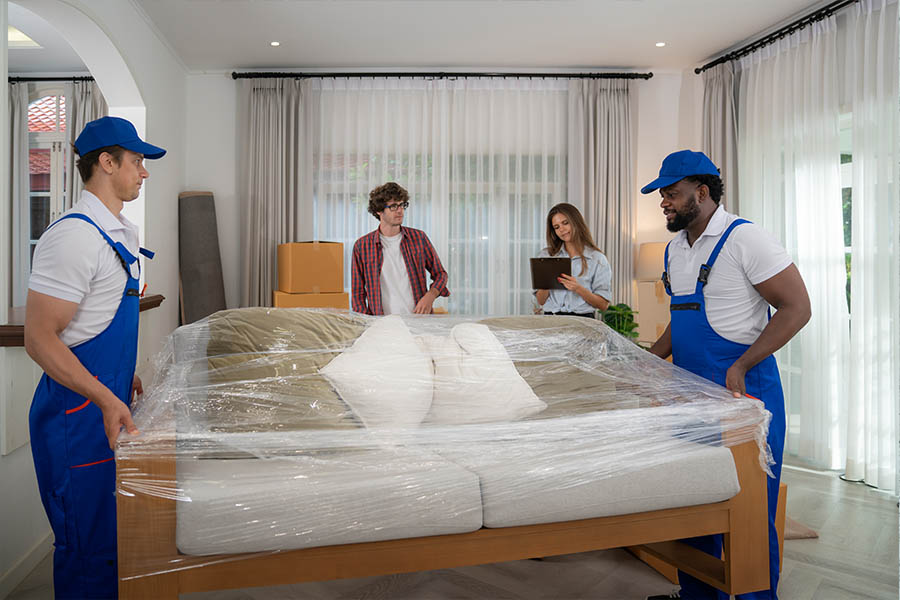
Here’s the thing about logistics: Preparation is 90% of the battle. For a full supplies list, check our packing tips hub. If you wait until the truck is idling in the driveway to figure out how to pack mattress for moving, you’re already behind.
You need the right tools. Think of this like surgery – you wouldn’t go in without a scalpel. You shouldn’t move a bed without a bag.
How to Prepare the Mattress for Moving
Okay, you have your supplies. Now, let’s get the bed ready. This isn’t just about wrapping it up; it’s about preserving the structure.
Get matched with the best mover for your needs!
Thank you!
Your movers will contact you shortly.
How to Move the Mattress Safely
Now comes the heavy lifting. The strategy depends on where you are and what kind of mattress you have.
Carrying Tips
When you lift, you want to keep the mattress vertical (on its side). Never carry it flat. A flat mattress is floppy and impossible to see over.
The “C” Shape: If the mattress is floppy (like memory foam), it will try to buckle. You can use this to your advantage. Fold it slightly into a “C” shape so it’s more rigid, and have one person at the front and one at the back.
The Staircase Pivot: This is the hardest part. When going down stairs, the person at the bottom carries the bulk of the weight.
- Bottom person: Holds the bottom corner and guides the angle.
- Top person: Controls the speed and pushes gently.
- Communication is key. Count it down: “One, two, three, step.”
Using a Dolly
If you are on flat ground, put the mattress on its long side on a four-wheel dolly. Have one person balance it while the other pushes. This saves your back and speeds up the process significantly.
If you are using a two-wheel hand truck, be careful. The metal plate can dig into the mattress. Put a piece of cardboard between the metal and the mattress to prevent punctures.
How to Load and Transport a Mattress
This is where the rubber meets the road – literally. How to transport a mattress depends entirely on your vehicle.
Special Tips for Different Mattress Types
Not all mattresses are created equal. My background in logistics taught me that different materials behave differently under stress.
Unloading and Setting Up the Mattress
You made it. You’re at the new house. The coffee pot isn’t unpacked yet, but you need a place to sleep.
Inspect for Damage
Before you cut that bag open, look at it. Did the plastic tear? Is there dirt on the mattress? If there is mud on the plastic, wipe it off before you slide the mattress out so you don’t transfer the dirt to the fabric.
Let It Air Out
Mattresses absorb smells. If it’s been in a plastic bag in a hot truck for three days, it’s going to smell like… well, hot plastic. Open the windows. Lean the mattress against a wall for an hour or two before you put the sheets on. Let it breathe.
Reassemble the Bed Frame
Here is a mistake I’ve made: I unpacked the mattress before I put the bed frame together. Then I had a giant mattress in the middle of the room and no space to build the frame. Build the frame first. Then bring the mattress in.
Planning a move? Find the perfect mover to match your needs and make your relocation stress-free!
877-792-7972Common Mistakes to Avoid
I’ve seen a lot of moves go sideways. Here are the pitfalls to watch out for:
- Using the handles to carry: Those little fabric handles on the side of the mattress? They are for positioning the mattress on the box spring, not for carrying 100 pounds down a flight of stairs. They will rip. Grip the bottom of the mattress.
- Dragging it: Even in a bag, dragging causes friction heat that can melt the plastic and burn the fabric. Lift it.
- Folding it like a taco: Unless the manufacturer specifically says it’s okay (like some bed-in-a-box brands), folding a mattress ruins the internal structure.
- Packing it wet: If it rains on moving day and your mattress gets damp, do not wrap it in plastic immediately. You will grow a mold colony by the time you reach your destination. It must be dry.
Mattress Moving Checklist (Printable Style)
- Buy a heavy-duty mattress bag (2 mil+).
- Buy ratchet straps (if using a truck).
- Clear a path from the bedroom to the door (move tripping hazards).
- Remove all bedding and pillows.
- Vacuum the mattress.
- Bag the mattress and tape it shut.
- Disassemble the bed frame.
- Plan the route (measure doorways and stairwells).
- Load the mattress first (against the wall).
- Secure it so it doesn’t shift.
Moving is exhausting. I get it. By the end of the day, your muscles ache, you’re hungry, and you just want to collapse. But taking the extra twenty minutes to properly wrap and transport your mattress ensures that when you do finally collapse, you have a clean, comfortable place to land.
My dad used to say, “Take care of your tools, and they’ll take care of you.” A mattress is the most important tool you have for a good day’s work. Treat it with respect.
And hey, if reading all this makes you think, “I do not want to lift this thing,” I don’t blame you. That’s what pros are for. Check out our directory at All Movers to find licensed, vetted movers who can handle the heavy lifting while you supervise with a cold drink.
Sleep tight!
Frequently Asked Questions (FAQ)
What's the easiest way to move a heavy mattress?
The easiest way is to use a mattress dolly or a four-wheel furniture cart. By balancing the mattress on its side on the dolly, you remove the need to carry the weight. If you don’t have a dolly, use “mattress lifting straps” (like the Forearm Forklift), which redistribute the weight to your shoulders and forearms, making it feel significantly lighter.
Is it hard to move a mattress by yourself?
Honestly? Yes. It is difficult and awkward. How to move a queen mattress by yourself usually involves sliding it on a heavy blanket or cardboard so you don’t have to lift it. You can stand it on its side and “walk” it by pivoting corner to corner, but it’s risky for your back. I strongly recommend finding a helper – or just hire a two-person crew. For everything else going in the truck, see our truck rental vs. movers guide.
Does a mattress really need 72 hours to expand?
If you have a compressed “bed-in-a-box” foam mattress, yes. While it might look fluffy after a few hours, the internal foam cells need time to fully fill with air to provide proper support. Sleeping on it too early can prevent it from reaching its full height and comfort level.
How much does it cost to move a queen size mattress?
If you are hiring movers just for a few items, many have a minimum charge (usually 2–3 hours of labor). Use our moving cost calculator to estimate costs for your city. If you are shipping just a mattress cross-country, uShip or similar freight services might charge $300-$600. Often, for long-distance moves, it’s often cheaper to buy a new mattress at the destination than to ship an old one. Compare options through our long-distance moving services page first.
How do you protect a mattress during a move?
The gold standard is a heavy-duty plastic mattress bag (sealed with tape) followed by a layer of moving blankets if it’s going into a truck with other furniture. This protects against dirt, moisture, and physical punctures.
Can you bend or fold a mattress?
Generally, no. Innerspring mattresses should never be folded. Hybrid mattresses should not be folded. Memory foam and latex mattresses can sometimes be folded temporarily (tied with straps) to get around tight corners, but keeping them folded for long periods can damage the foam. Always check the manufacturer’s warranty first.
What’s the safest way to move a mattress?
The safest way is with two people, using a mattress bag for grip and hygiene, carrying it vertically (on its side). Keep your back straight, lift with your legs, and communicate clearly when navigating stairs.
Can I transport a mattress on the roof of my car?
Technically, you can, but you shouldn’t. It is dangerous. If you must do it for a very short, low-speed trip: use a mattress bag, run heavy-duty ratchet straps through the windows (not just the roof rack), and tie the front and back down to the bumpers to prevent the wind from folding it up. But please, just rent a van. See our truck rental cost breakdown – it’s cheaper than you think, and far safer.
How do I strap a mattress for transport?
In a truck, lean the mattress against the side wall. Use ratchet straps or rope to anchor it to the wall rails. Place a piece of cardboard under the strap where it touches the mattress so it doesn’t cut into the foam. Tighten it enough so it doesn’t wiggle, but not so tight that you crush the bed.
Should I clean a mattress before moving it?
Yes. Vacuuming it removes dust, skin cells, and mites. If there are stains, spot clean them with a mild enzyme cleaner and let it dry completely before bagging. This prevents odors and bacteria from growing inside the plastic bag during the move.